


Low-Code Development Platform Market: Global Insights, Trends, and Forecast to 2030
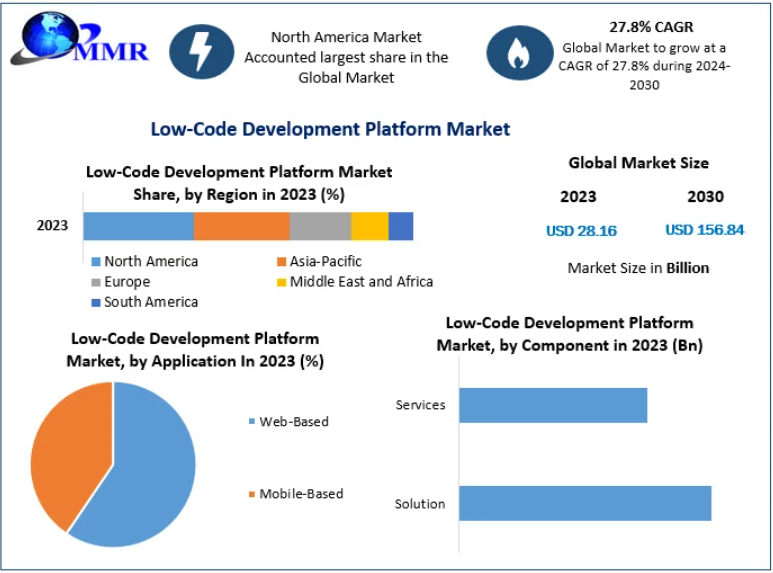
The Low-Code Development Platform Market is experiencing explosive growth as organizations accelerate digital transformation and seek faster, more cost-efficient ways to build applications. Valued at USD 28.16 billion in 2023, the market is set to surge to USD 156.84 billion by 2030, expanding at an impressive CAGR of 27.8% from 2024 to 2030. Low-code solutions are reshaping how enterprises develop software, democratizing application creation and bridging the global IT skills gap.
To know the most attractive segments, click here for a free sample of the report:https://www.maximizemarketresearch.com/request-sample/55407/
Market Overview
Low-code development is a visual, abstraction-driven approach that enables application creation through graphical interfaces, drag-and-drop tools, prebuilt templates, and reusable components. These platforms empower both professional developers and “citizen developers”—including business users, analysts, and designers—to build and deploy applications without deep programming expertise.
With increasing digital dependency across industries, low-code platforms offer critical advantages:
- Faster application development
- Lower development and maintenance costs
- Automation of workflows and business operations
- Reduced reliance on specialized IT experts
- Accelerated innovation cycles
The growing prevalence of remote work, cloud adoption, BYOD (Bring Your Own Device), and digital-first business strategies is further fueling the rise of low-code technologies.
- Market Dynamics
- Key Growth Drivers
- Rapid Digitalization Across Enterprises
Global businesses are prioritizing modernization of legacy systems and digital transformation. According to Dell’s Digital Transformation Index, 80% of enterprises accelerated their digital initiatives in 2020. Low-code platforms help frontline business teams create apps without relying heavily on scarce IT resources.
- Rising Demand for Business Process Automation
Organizations are automating manual, repetitive, and paper-based workflows to improve:
- Productivity
- Cost efficiency
- Accuracy
- Customer experience
Low-code platforms offer built-in workflow engines, connectors, and visual process modeling tools, enabling non-technical users to automate complex processes.
- Smart Integration Through APIs and Microservices
With the rise of cloud architectures, microservices, and function-as-a-service (FaaS), enterprises often operate fragmented IT ecosystems. Low-code platforms provide “smart stitching” capabilities to integrate existing applications quickly using built-in APIs and connectors.
This allows businesses to develop domain-specific applications rapidly while maintaining continuity across older systems.
- Market Challenges
- Limited Software Integration Capabilities
Not all low-code solutions integrate effortlessly with third-party systems. Limited connector libraries and proprietary architectures can restrict platform flexibility.
- Constraints in Customization
Certain platforms limit advanced customization, which can impede adoption among businesses needing highly tailored applications.
- Vendor Lock-In Concerns
As enterprises build mission-critical systems on low-code platforms, switching vendors becomes increasingly complex.
Despite these constraints, continuous technological improvements and platform upgrades are mitigating these challenges.
- Segment Analysis
By Industry
BFSI — Leading Segment (30%+ revenue share in 2023)
The banking, financial services, and insurance industry is the largest adopter of low-code platforms. Key drivers:
- Digitization of onboarding, loan origination, KYC, claims, and customer service
- Demand for faster time-to-market in digital banking
- Heavy reliance on legacy systems needing modernization
- Regulatory compliance requirements
- Growing need for reusable, secure software components
Low-code helps BFSI institutions accelerate innovation while reducing technical debt.
Other Key Industries
- Telecom & IT – network management, customer apps
- Government – citizen service portals, workflow apps
- Healthcare & Life Sciences – patient engagement, lab workflows
- Retail & Ecommerce – omnichannel apps, analytics dashboards
- Manufacturing – supply chain automation, smart factory apps
- Education – student portals, LMS systems
- Regional Insights
North America — Market Leader (35% share in 2023)
Key drivers:
- Strong presence of major vendors such as Appian, Salesforce, ServiceNow, Microsoft
- High digital maturity of enterprises
- Significant R&D investments
- Widespread cloud adoption
Recent innovations like Claris Connect (Apple subsidiary) and the launch of ServiceNow’s expanded low-code capabilities in Canada illustrate the region’s innovation leadership.
Asia Pacific — Fastest-Growing Region
Factors boosting growth:
- Rising adoption of low-code among SMEs
- Government-led digitalization initiatives
- Rapid growth in India and China
- Scarcity of high-skilled IT workers
- Increasing cloud adoption and workflow digitization
India’s “Atmanirbhar Bharat” initiative is creating new opportunities for low-code platform developers.
Europe
Growing demand from BFSI, healthcare, education, and retail. The UK, Germany, and France are major adopters. Brexit-driven shifts and post-pandemic recovery are influencing digital strategies.
South America & Middle East & Africa
Gradual adoption driven by:
- Growing digital transformation
- Scarcity of IT talent
- Increasing demand for workflow automation
Brazil leads in South America, while GCC nations are accelerating low-code adoption as part of smart government initiatives.
- Market Segmentation Summary
By Component
- Solution
- Services
By Deployment
- On-Premises
- Cloud
By Application Type
- Web-Based
- Mobile-Based
By Organization Size
- SMEs
- Large Enterprises
By Industry
- BFSI
- Telecom & IT
- Government
- Energy & Utilities
- Manufacturing
- Healthcare & Life Sciences
- Retail & Ecommerce
- Media & Entertainment
- Education
- Others (Travel, Tourism, Logistics)
To know the most attractive segments, click here for a free sample of the report:https://www.maximizemarketresearch.com/request-sample/55407/
Key Market Players
Leading Companies
- Caspio (US)
- OutSystems (US)
- Appian (US)
- Salesforce (US)
- Quickbase (US)
- LANSA Inc. (US)
- ServiceNow (US)
- AgilePoint (US)
- Bizagi (US)
- Microsoft (US)
- Oracle (US)
- Pegasystems (US)
- KissFlow (US)
- Blazedpath (US)
- Mendix (Netherlands)
- Appsemble (Netherlands)
- Novulo (Netherlands)
- Smart Shaped SRL (Italy)
- Aurachain (Romania)
- ClickPaas (China)
- eNextCloud (India)
- Zoho Corporation (India)
- Magic Software Enterprises (Israel)
These companies focus on enhancements in AI-driven automation, cloud-native development, reusable templates, and hyperautomation capabilities.
- Future Outlook
The low-code development market is poised for exponential growth powered by:
- AI-assisted development and automated coding
- Expansion of enterprise automation
- Increasing demand for multi-experience applications
- Growth in citizen developer ecosystems
- Integration of low-code with DevOps and cloud-native infrastructures
By 2030, low-code platforms will become a mainstream development approach across global enterprises, transforming how applications are built and delivered.
Conclusion
The Low-Code Development Platform Market is entering a new era defined by speed, agility, and innovation. As industries accelerate digital transformation and embrace automation, low-code platforms provide the critical tools needed to overcome the global IT talent shortage and deliver rapid application development. With strong growth prospects across North America, Europe, and Asia Pacific, the market is set to become one of the most dynamic segments of the global software industry by 2030.