


Global Advanced Analytics Market: Growth, Trends, and Strategic Outlook
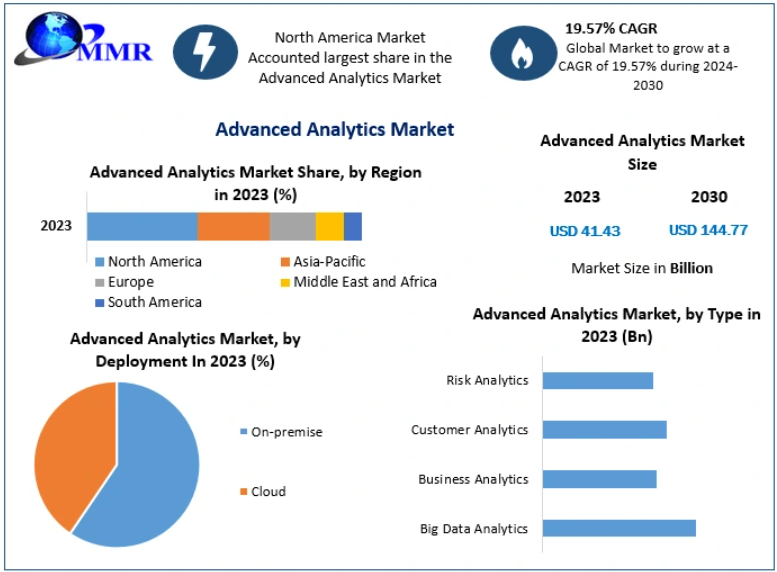
The global Advanced Analytics Market is undergoing a rapid transformation as organizations increasingly rely on data-driven intelligence to gain a competitive edge. Valued at USD 41.43 billion in 2023, the market is projected to grow at a robust CAGR of 19.57% from 2024 to 2030, reaching nearly USD 144.77 billion by the end of the forecast period. This strong growth reflects the accelerating demand for sophisticated analytical tools that move far beyond traditional business intelligence.
What is Advanced Analytics?
Advanced analytics refers to the use of sophisticated data analysis techniques that enable organizations to uncover deep insights, predict future outcomes, and generate actionable recommendations. Unlike conventional reporting and dashboards, advanced analytics leverages technologies such as machine learning, artificial intelligence, data and text mining, neural networks, pattern recognition, and predictive modeling.
These techniques support a wide range of analytical capabilities, including forecasting, sentiment analysis, network and cluster analysis, simulation, graph analytics, multivariate statistics, and complex event processing. By enabling autonomous or semi-autonomous data exploration, advanced analytics empowers enterprises to make smarter, faster, and more informed decisions across business functions.
To know the most attractive segments, click here for a free sample of the report:https://www.maximizemarketresearch.com/request-sample/208671/
Market Overview and Growth Drivers
The growth of the advanced analytics market is largely driven by digital transformation initiatives across industries. As enterprises digitize operations and customer interactions, the volume, velocity, and variety of data continue to grow exponentially. In 2023 alone, global digital transformation spending reached nearly USD 2 trillion, highlighting the scale at which organizations are investing in data-centric technologies.
Social media platforms, e-commerce, mobile applications, and connected devices generate massive data streams that require advanced analytics for real-time processing and insight extraction. Businesses are increasingly turning to AI- and ML-powered analytics platforms to convert this data into meaningful intelligence.
Strategic partnerships and investments are also shaping the market landscape. For instance, the Wipro–DataRobot collaboration announced in April 2023 aimed to enhance AI-driven consumer insights and accelerate enterprise adoption of advanced analytics. Similarly, advancements in big data technologies continue to expand analytics capabilities across industries.
Key Market Dynamics
Rising Digitization and Data Explosion
The accelerating pace of digitization is one of the most influential forces shaping the advanced analytics market. As consumers become more digitally connected, data creation has surged across sectors such as retail, healthcare, finance, and transportation. Advanced analytics tools play a critical role in managing and interpreting this data, enabling organizations to optimize decision-making and operational efficiency.
Global digital spending is expected to approach USD 4 trillion, reinforcing the importance of analytics in driving business value and long-term growth.
Growing Demand for Data-Driven Optimization
Businesses are increasingly adopting analytics solutions to better understand customer behavior and personalize engagement strategies. Advanced analytics enables the creation of detailed customer profiles, supporting targeted marketing, demand forecasting, and performance optimization.
Insights-driven organizations consistently outperform their peers. Studies show that such businesses are significantly more likely to experience revenue growth, customer acquisition success, and competitive differentiation. Despite these benefits, fewer than 10% of organizations are fully insights-driven, indicating substantial untapped potential in the market.
The integration of AI and machine learning has further enhanced analytics capabilities, enabling deeper insights, faster decision-making, and improved customer experiences. These technologies have transformed how organizations collect, process, and interpret data.
Technology Proliferation and Industry Adoption
The widespread availability of internet connectivity and advanced digital technologies has increased the number of customer touchpoints across industries. Sectors such as healthcare, BFSI, retail, transportation, and government are increasingly adopting advanced analytics to improve outcomes, manage risks, and enhance service delivery.
Healthcare, in particular, is emerging as a high-growth vertical, with analytics supporting predictive diagnostics, patient monitoring, and operational efficiency.
Market Challenges
Despite strong growth prospects, the advanced analytics market faces several challenges. A key barrier is the lack of skilled professionals capable of effectively implementing and interpreting advanced analytics solutions. Many organizations struggle to translate analytical outputs into actionable business strategies.
Additionally, high implementation costs and difficulties in accurately measuring return on investment (ROI) continue to hinder adoption, especially among small and medium enterprises. Addressing these concerns through cost-effective solutions, training programs, and clearer value demonstrations will be critical for sustained market expansion.
Segment Analysis
By Deployment
In 2023, cloud-based advanced analytics solutions dominated the market. Cloud deployment offers scalability, flexibility, rapid implementation, and cost efficiency through pay-as-you-go pricing models. Organizations benefit from reduced IT overhead, seamless collaboration, and easy integration with other cloud services, making cloud analytics the preferred choice for enterprises of all sizes.
By Type
The market is segmented into big data analytics, business analytics, customer analytics, risk analytics, statistical analysis, and other advanced analytics types. Big data analytics is expected to capture around 35% market share by 2030, driven by the explosive growth of digital platforms, social media, and SaaS-based analytics tools. Increasing investments in cloud infrastructure further support the expansion of this segment.
To know the most attractive segments, click here for a free sample of the report:https://www.maximizemarketresearch.com/request-sample/208671/
Regional Insights
North America is projected to dominate the advanced analytics market, accounting for approximately 45% of global revenue by 2030. The region benefits from strong technological infrastructure, early adoption of AI and ML, and the presence of major solution providers such as Microsoft, Oracle, IBM, and SAP. Strategic collaborations, including Microsoft’s partnership with CVS Health, continue to accelerate innovation.
The Asia Pacific region is expected to emerge as the second-largest market, with around 24% share by 2032. Rapid digitalization, growing adoption of big data analytics, and rising investments in customer analytics across industries are driving market growth. Sectors such as travel, transportation, and e-commerce are key contributors to analytics adoption in the region.
Competitive Landscape
The advanced analytics market is moderately competitive, with leading players focusing on innovation, partnerships, and cloud-based offerings. Key companies operating in the market include Microsoft Corporation, Oracle Corporation, SAP SE, Altair Engineering, KNIME AG, RapidMiner, TIBCO Software, MicroStrategy, FICO, Sisense, and ThoughtSpot.
Conclusion
The global advanced analytics market is set for sustained growth as organizations increasingly prioritize data-driven decision-making. With advancements in AI, machine learning, and cloud technologies, advanced analytics is becoming a strategic necessity rather than a competitive advantage. While challenges related to skills and ROI persist, ongoing innovation and increasing awareness are expected to unlock significant opportunities across industries worldwide.