


Agricultural Adjuvants Market Outlook: 2024–2030
Market Overview
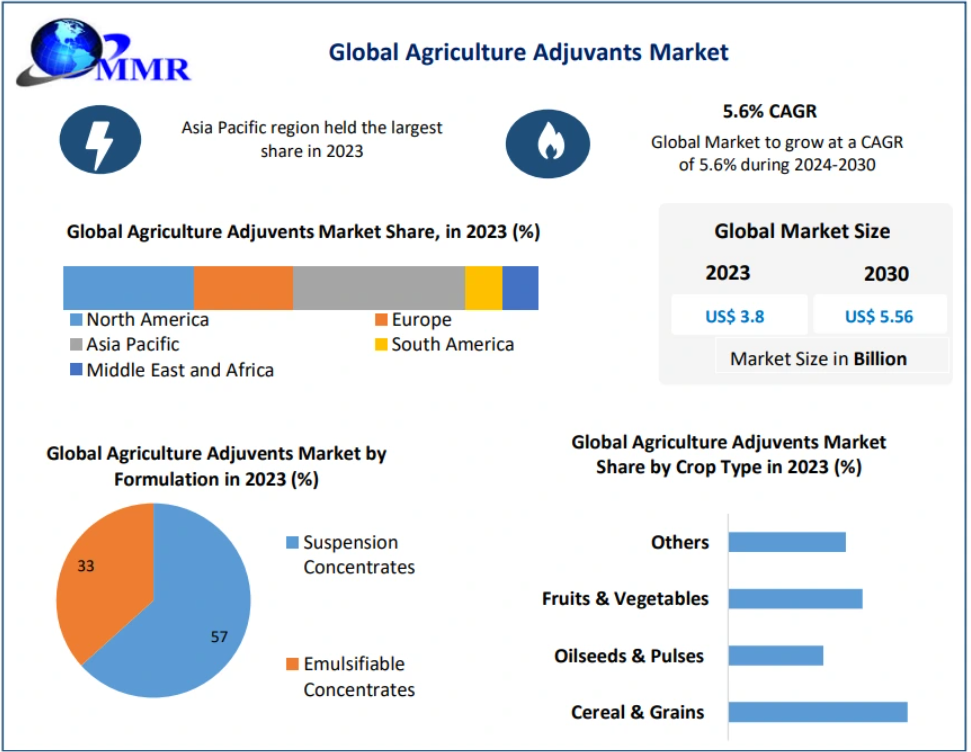
The global Agricultural Adjuvants Market was valued at USD 3.8 billion in 2023 and is projected to expand at a CAGR of 5.6% between 2024 and 2030, reaching approximately USD 5.56 billion by 2030. This growth is being driven by the rising need for efficient crop protection solutions, increasing food demand from a growing global population, and the ongoing transformation toward sustainable agricultural practices.
Agricultural adjuvants are auxiliary substances added to pesticides, herbicides, fungicides, and insecticides to enhance their performance. These compounds improve spray retention, absorption, penetration, and stability, enabling agrochemicals to function more effectively. Adjuvants are widely used across diverse agricultural settings, including open-field farming, horticulture, and greenhouse cultivation.
With modern agriculture emphasizing productivity, cost-efficiency, and environmental responsibility, adjuvants have become an integral component of advanced crop management strategies.
To know the most attractive segments, click here for a free sample of the report:https://www.maximizemarketresearch.com/request-sample/199815/
Market Scope and Research Approach
The Agricultural Adjuvants Market report provides a structured evaluation of the global industry, covering segmentation by formulation type, function, application, crop type, and adoption stage. A bottom-up research methodology has been used to estimate and forecast market size, combining primary industry interviews with secondary data from company reports, regulatory filings, and agricultural associations.
The report assesses competitive positioning by comparing market leaders, followers, and emerging players. It further examines regulatory influences, technological advancements, sustainability trends, and regional dynamics shaping market growth across global, regional, and local levels.
Market Dynamics
Key Growth Drivers
- Shift Toward Sustainable Agriculture
The global agricultural sector is increasingly transitioning toward sustainable farming practices to minimize chemical residues and environmental harm. This shift has encouraged the development of bio-based and green adjuvants, derived from renewable sources such as modified vegetable oils and organo-modified siloxanes. Governments and manufacturers alike are prioritizing non-toxic, biodegradable formulations that align with evolving regulatory standards and consumer expectations. - Rising Global Food Demand
Rapid population growth is driving the need for higher agricultural productivity. To meet food security goals, farmers are adopting advanced crop protection strategies that rely heavily on adjuvants to maximize agrochemical efficiency. By improving spray coverage and penetration, adjuvants help enhance pest and disease control while reducing overall chemical usage. - Advancements in Farming Techniques
The adoption of modern agricultural practices—such as mechanized spraying, smart irrigation systems, and precision agriculture—is boosting adjuvant consumption. These technologies require highly compatible formulations that ensure uniform distribution and optimal chemical performance.
Market Restraints
- Regulatory Pressures
Stringent regulations in major agricultural economies pose a challenge to market growth. For instance, in the United States, all adjuvants must comply with FIFRA regulationsand undergo EPA registration to ensure safety for human health and the environment. Similar regulatory frameworks exist across Europe and Asia, increasing compliance costs and slowing product approvals. - Environmental and Health Concerns
Petroleum-based oil adjuvants are facing declining demand due to their potential environmental impact. These products can release micro-droplets and oil mists into the atmosphere, raising health and ecological concerns. This has led to a growing shift toward safer alternatives, constraining traditional product segments. - Supply Chain Disruptions
Ongoing raw material shortages and shipping delays have created uncertainties in production schedules and pricing. These supply chain challenges affect product availability and complicate strategic planning for manufacturers.
Market Opportunities
- Precision Farming Adoption
Precision agriculture represents one of the most promising growth opportunities for the agricultural adjuvants market. Techniques such as drone spraying, variable-rate application, and automated irrigation systems rely on highly specialized adjuvants to ensure accurate and efficient agrochemical delivery. This creates strong demand for customized formulations designed specifically for digital farming platforms. - Expansion in Emerging Economies
Fast-growing agricultural markets such as China and Indiaoffer untapped potential. Rising food demand, expanding arable land utilization, and government-backed agricultural modernization programs are encouraging higher adoption of adjuvants in these regions. - Growth of Green Adjuvants
Consumer preference for organic and sustainably produced food is driving interest in eco-friendly adjuvants. Manufacturers are increasingly investing in biodegradable, plant-based formulations that reduce chemical runoff and improve soil health, creating new revenue streams within the market.
Segment Analysis
By Application
The market is segmented into Herbicides, Insecticides, Fungicides, and Others.
- Herbicides held the largest market share in 2023. Weed control remains a critical agricultural challenge, as weeds compete with crops for nutrients, sunlight, and water. The rise of herbicide-resistant weed species has further intensified reliance on adjuvants to improve herbicide efficacy and overcome resistance issues.
- Insecticides and Fungicides are also witnessing steady growth due to increasing pest infestations and fungal diseases, driven partly by climate change and changing crop patterns.
To know the most attractive segments, click here for a free sample of the report:https://www.maximizemarketresearch.com/request-sample/199815/
Regional Insights
Asia-Pacific
Asia-Pacific dominated the agricultural adjuvants market in 2022 and is expected to retain its leadership through 2030. Agriculture remains a major economic pillar in countries such as India and China, where large rural populations depend on farming for their livelihoods. Rising food consumption, modernization of farming techniques, and increased use of crop protection chemicals are fueling regional market growth.
North America
North America represents one of the fastest-growing regions in the market. Extensive cultivation of crops such as corn and soybeans, combined with widespread use of advanced farming technologies, has resulted in high adjuvant consumption. Additionally, strong regulatory support for sustainable agriculture and ongoing R&D investments are strengthening market expansion in the United States and Canada.
Europe
Europe is characterized by strict environmental regulations and high adoption of green agricultural inputs. This has accelerated the shift toward biodegradable adjuvants and bio-based formulations across the region.
Middle East & Africa and South America
These regions are gradually emerging as growth markets, supported by expanding agricultural investments, improved irrigation infrastructure, and increased awareness of crop productivity enhancement solutions.
Competitive Landscape
The Agricultural Adjuvants Market is highly competitive, with both global chemical giants and specialized agricultural solution providers striving to strengthen their market positions. Key competitive strategies include mergers and acquisitions, strategic collaborations, product innovation, and geographic expansion.
Notable companies operating in the market include:
- Attune Agriculture
- BASF SE (Germany)
- Bayer CropScience
- Clariant AG (Switzerland)
- Corteva (U.S.)
- Croda International Plc (U.K.)
- Dow (U.S.)
- Evonik Industries AG (Germany)
- GarrCo Products Inc.
- Helena Agri-Enterprises LLC
- Ingevity (U.S.)
- Lamberti S.p.A. (Italy)
- Loveland Products, Inc. (U.S.)
- Miller Chemical & Fertilizer, LLC (U.S.)
- Momentive (U.S.)
- Nouryon (Netherlands)
- Nufarm Canada (Canada)
- Solvay (Belgium)
- Stepan Company (U.S.)
- Syngenta (Switzerland)
- WinField Solutions LLC
Leading players are increasingly focusing on sustainable product development, digital farming compatibility, and expansion into high-growth emerging markets.
Conclusion
The Agricultural Adjuvants Market is set for consistent growth through 2030, supported by rising food demand, technological advancements in farming, and the global transition toward sustainable agriculture. Although regulatory pressures and supply chain challenges remain key concerns, opportunities in precision farming and green adjuvants are expected to unlock new growth avenues.
As agriculture continues to evolve into a data-driven and environmentally conscious industry, agricultural adjuvants will play an increasingly critical role in improving crop protection efficiency, reducing chemical waste, and supporting global food security goals.
Utterly composed articles, Really enjoyed looking through.
References:
Are anabolic steroids legal in the us
References:
https://servus-nachbar.at/Neuigkeiten/index.php/;focus=W4YPRD_com_cm4all_wdn_Flatpress_7491266&path=&frame=W4YPRD_com_cm4all_wdn_Flatpress_7491266?x=entry:entry240508-153824%3Bcomments:1
References:
Eql anavar
References:
http://81.69.229.51:3000/cyrus57k436781
References:
Natural steriods
References:
https://www.familienzentrum-stmichael-lampertheim.de/Blog/index.php/;focus=STRATP_com_cm4all_wdn_Flatpress_14129025&path=&frame=STRATP_com_cm4all_wdn_Flatpress_14129025?x=entry:entry181112-113232%3Bcomments:1
References:
Bodybuilding drug list
References:
https://www.kraftplatz-weibel.ch/blog/index.php/;focus=HSTPTP_com_cm4all_wdn_Flatpress_9497677&path=&frame=HSTPTP_com_cm4all_wdn_Flatpress_9497677?x=entry:entry250410-212902%3Bcomments:1
References:
Are anabolic steroids safe
References:
https://wm01oaq9b.hier-im-netz.de/Blog;focus=TKOMSI_com_cm4all_wdn_Flatpress_23962032&path=&frame=TKOMSI_com_cm4all_wdn_Flatpress_23962032?x=entry:entry220822-104714%3Bcomments:1