


Asset-Based Lending Market: Global Trends, Growth Forecast, and Industry Insights (2025–2032)
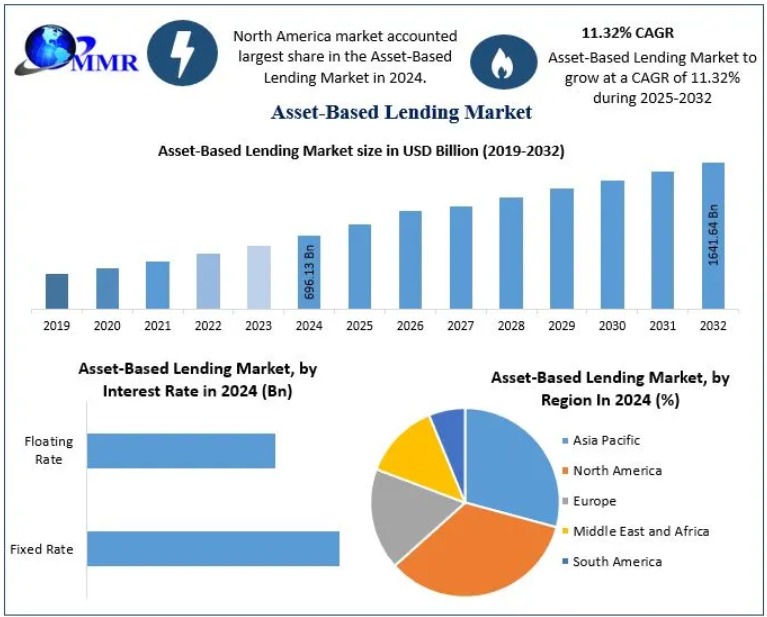
The Asset-Based Lending (ABL) Market is experiencing unprecedented growth as businesses across industries seek more flexible, collateral-driven funding solutions. The market was valued at USD 696.13 billion in 2024 and is projected to reach USD 1,641.64 billion by 2032, growing at a strong CAGR of 11.32% during the forecast period. This growth reflects a global shift toward financing models that prioritize asset value over credit strength, enabling more accessible and scalable funding options for companies of all sizes—particularly SMEs.
What is Asset-Based Lending (ABL)?
Asset-based lending is a financing approach in which loans are secured using business assets rather than credit scores. These assets include:
- Accounts receivable
- Inventory
- Equipment
- Real estate
- Other high-value business assets
Unlike traditional bank loans that rely heavily on creditworthiness and financial history, ABL focuses on asset liquidity, making it a viable option for businesses with limited credit access, inconsistent cash flows, or capital-intensive operations.
Lenders determine loan amounts based on an advance rate, typically:
- 70–90% of receivables
- 40–60% of inventory
- Up to 80% of equipment value
This allows companies to unlock working capital tied up in operational assets.
To know the most attractive segments, click here for a free sample of the report:https://www.maximizemarketresearch.com/request-sample/189641/
Market Drivers
- Rising Need for Liquidity Among Businesses
One of the strongest drivers of ABL adoption is the increasing need for immediate liquidity. Companies facing cash-flow challenges, seasonal revenue drops, or aggressive expansion goals benefit from ABL’s ability to convert assets into working capital rapidly.
- Easier Qualification Compared to Traditional Loans
ABL programs offer lenient qualification criteria, making them ideal for:
- SMEs
- Businesses undergoing restructures
- Firms with fluctuating performance
For these businesses, assets such as invoices and inventory can secure funding—even without strong financial histories.
- Growing SME Sector
SMEs represent 90% of global businesses and generate over 50% of employment worldwide. Yet, more than 40% face unmet financing needs worth USD 5.2 trillion annually, according to the IFC. ABL is bridging this gap by offering more flexible and accessible funding options.
- Innovative ABL Products Boost Market Growth
Major lenders are expanding their product portfolios. For example, Metro Bank (UK) launched a new ABL product offering credit of over USD 2.4 million backed by a broad set of business assets, intensifying global market innovation and competition.
- Technology Advancement in Asset Monitoring
ABL is increasingly adopting:
- AI-driven collateral valuation
- Automated invoice verification
- Real-time inventory tracking
These technologies enhance transparency, reduce risk, and accelerate credit approvals.
Market Challenges
Despite rapid growth, the ABL market faces obstacles:
- High monitoring requirements for collateral
- Fluctuating asset values, especially inventory
- Higher administrative costs relative to traditional loans
- Regulatory complexities in cross-border lending
However, technological advancements and improved risk-assessment models continue to mitigate these challenges.
Asset-Based Lending Market Segmentation
By Type
- Receivables Financing – Largest Segment (2024)
- Dominated the market with the highest revenue share
- Expected CAGR: 9.1%
- Key benefits: rapid cash release, improved cash flow, lower default risk
- Inventory Financing
- Popular among retail, manufacturing, and wholesale sectors
- Helps businesses navigate seasonal demand cycles
- Equipment Financing
- Supports capital-intensive industries
- Enables equipment upgrades without upfront capital burden
By End User
SMEs – Dominant Segment
SMEs hold the highest market share due to limited access to traditional credit and the need for flexible collateral-based funding.
Large Enterprises
While less reliant than SMEs, large corporations use ABL for:
- Mergers & acquisitions
- Restructuring
- Expansion of operations
To know the most attractive segments, click here for a free sample of the report:https://www.maximizemarketresearch.com/request-sample/189641/
Regional Insights
- North America – Market Leader (37.8% share in 2024)
North America dominates the global ABL market due to:
- A mature financial system
- Presence of leading ABL institutions
- High adoption across retail, automotive, and manufacturing sectors
Expected growth: CAGR of 10.12% by 2032
- Europe
Europe is growing rapidly due to:
- Strong regulatory support for recycling and transparency
- Increasing SME financing needs
- Expansion of cross-border ABL services
- Asia Pacific
APAC’s ABL market is driven by:
- Industrial expansion in China, India, and Southeast Asia
- Demand for working capital among manufacturing-focused SMEs
- Rising adoption of fintech lending solutions
- Latin America & Middle East
These regions have a large unmet credit demand among SMEs, making ABL a rapidly growing financing tool.
Competitive Landscape – Key Players
Major companies operating in the market include:
- Lloyds Bank
- Barclays Bank PLC
- JPMorgan Chase & Co
- Wells Fargo
- Hilton-Baird Group
- Porter Capital
- HSBC Holdings
- Goldman Sachs
- SLR Credit Solutions
- Berkshire Bank
- Truist Financial Corporation
- Santander Bank
- KeyCorp
- Capital Funding Solutions Inc.
These players focus on product innovation, automation, and regional expansion.
Market Trends Shaping the Future of ABL
- Tech-enabled collateral monitoring
- Growth of digital ABL platforms
- Expansion of cross-border lending solutions
- Rising adoption among e-commerce and logistics companies
- Shift from cash-flow lending to asset-driven financing
Conclusion
The Asset-Based Lending Market is set for robust expansion, driven by the growing need for liquidity, rising SME financing gaps, and the emergence of innovative, technology-driven lending models. As businesses seek faster, more flexible funding options, ABL is becoming a foundational component of global financial ecosystems—unlocking capital, supporting business growth, and shaping the future of enterprise financing.