


Indonesia Electric Vehicle Market: Driving the Nation Toward a Sustainable Future
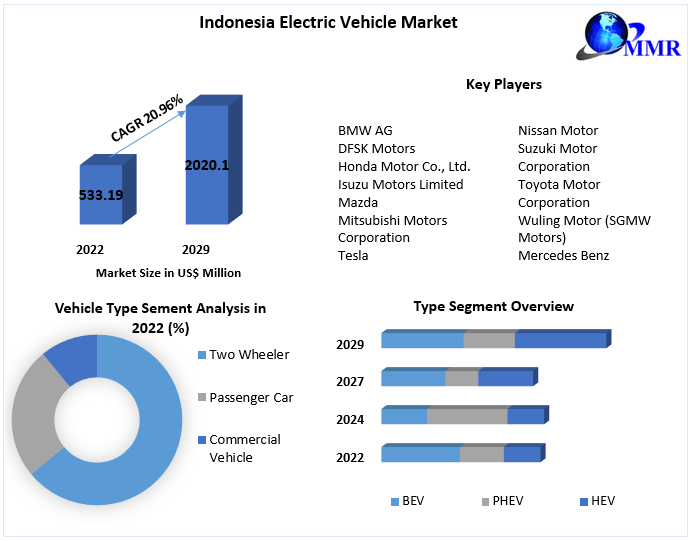
The Indonesia Electric Vehicle Market was valued at USD 533.19 million in 2022 and is projected to grow at a CAGR of 20.96% to reach USD 2,020.13 million by 2029. The growing focus on sustainability, government incentives, and abundant nickel reserves are positioning Indonesia as a critical player in the global EV ecosystem.
Market Overview
Indonesia’s shift toward electric mobility represents a strategic transformation in its transportation and industrial sectors. Backed by one of the world’s largest nickel reserves—vital for EV battery production—the country has the resources to become a global EV hub. Indonesia produced 760,000 tons of nickel in 2022, with reserves of over 21 million metric tons, accounting for nearly a quarter of global supply. These abundant natural resources, combined with a strong national roadmap and foreign investments, are laying the foundation for rapid EV industry growth.
However, Indonesia’s EV market remains in its early stages, with electric vehicles making up less than 1% of total vehicle sales in 2022. Yet, the growing public awareness of environmental concerns and favorable government initiatives indicate a clear shift toward electrification in the coming decade.
To identify the key high-growth segments, request your complimentary sample report by clicking here:https://www.maximizemarketresearch.com/request-sample/65817/
Market Dynamics
Key Growth Drivers
1. Abundant Nickel and Mineral Resources
Nickel is a critical raw material for lithium-ion batteries used in electric vehicles. Indonesia’s dominance in nickel reserves provides a strategic advantage in building a domestic EV supply chain. The nation also possesses significant copper and gold reserves, further supporting battery and EV component production.
2. Government Roadmap and Investments
Indonesia has laid out a $17 billion EV roadmap, targeting 2.1 million electric motorcycles and 400,000 electric cars by 2025, with an emphasis on local manufacturing. The government aims to transition to an all-electric bus fleet in Jakarta within the next decade.
PLN, the state-owned power company, has pledged to install over 31,000 EV charging stations by 2030, allocating $3.7 billion for public and commercial infrastructure.
3. Strategic Partnerships and Foreign Investments
South Korean giants Hyundai and LG signed a $1.1 billion MoU with the Indonesian government to establish an EV battery manufacturing plant in Karawang, West Java, with an expected annual output of 150,000 EV batteries. Additionally, global automakers like Toyota, Mitsubishi, and Tesla have shown interest in the Indonesian market, attracted by incentives and the potential for local sourcing.
4. Government Incentives and Policy Support
The government’s Positive Investment List (PIL) prioritizes EV manufacturing, offering up to 100% foreign ownership and tax holidays for large investors. For instance, investments exceeding IDR 500 billion receive a 100% corporate tax exemption, while smaller projects gain partial relief. Other benefits include 0% luxury tax on zero-emission vehicles and simplified licensing processes.
Challenges
Despite strong prospects, several challenges must be addressed:
-
Insufficient Charging Infrastructure: As of 2022, Indonesia had just 219 public charging stations spread across 185 locations—far below the required density to support widespread EV adoption.
-
High EV Costs: The average cost of an EV remains significantly higher than conventional vehicles, limiting affordability for middle-income consumers.
-
Consumer Mindset: Awareness of EV benefits is increasing, but concerns around battery life, charging convenience, and resale value persist.
-
Supply Chain Integration: The World Bank has cautioned that Indonesia’s limited integration with global EV supply chains could restrict its export potential without policy alignment and infrastructure readiness.
Segment Analysis
By Type
-
Hybrid Electric Vehicles (HEV) currently dominate Indonesia’s EV market, as they provide flexibility between electric and gasoline power, reducing dependence on charging infrastructure.
-
Battery Electric Vehicles (BEV) and Plug-in Hybrid Electric Vehicles (PHEV) are gradually gaining traction, driven by government incentives and new charging station deployments.
By Vehicle Type
-
Two-Wheelers are expected to lead EV adoption due to affordability and suitability for Indonesia’s urban landscape.
-
Passenger Cars will see robust growth with the entry of new models from Hyundai, Toyota, and Wuling Motors.
-
Commercial Vehicles such as e-buses and logistics fleets are also gaining attention under Jakarta’s urban mobility electrification plan.
Market Outlook
Indonesia’s EV market is transitioning from policy planning to practical implementation. By 2030, EV penetration is expected to rise significantly, with projections suggesting 250,000 passenger EVs and 1.9 million electric two-wheelers in operation. The government’s carbon reduction target of 29% by 2030 further reinforces the transition to cleaner mobility.
As the fourth most populous country globally, Indonesia represents a vast consumer base and a gateway for EV expansion in Southeast Asia. With sustained policy support, infrastructure investment, and industrial collaboration, Indonesia has the potential to become a regional EV manufacturing hub.
To identify the key high-growth segments, request your complimentary sample report by clicking here:https://www.maximizemarketresearch.com/request-sample/65817/
Competitive Landscape
Key players driving Indonesia’s EV ecosystem include:
-
Toyota Motor Corporation
-
Mitsubishi Motors Corporation
-
Hyundai Motor Company
-
Honda Motor Co., Ltd.
-
Nissan Motor Corporation
-
BMW AG
-
Mazda Motor Corporation
-
DFSK Motors
-
Suzuki Motor Corporation
-
Wuling Motors (SGMW)
-
Mercedes-Benz
-
Tesla, Inc.
These companies are actively investing in local production facilities, battery partnerships, and dealership networks to capture Indonesia’s rapidly evolving EV market.
Conclusion
The Indonesia Electric Vehicle Market stands at a transformative juncture. With vast nickel reserves, a supportive regulatory environment, and rising environmental awareness, Indonesia is well-positioned to emerge as a key EV production and consumption hub in Asia. Addressing infrastructure bottlenecks and consumer affordability will be crucial to sustaining this momentum and achieving the nation’s ambitious electrification goals.
References:
Steroids definition
References:
https://hedgedoc.eclair.ec-lyon.fr/s/vcfeGw31M
References:
Legit research chemical supplies sites bodybuilding
References:
https://md.ctdo.de/s/6XN6SW_R7Z
References:
How anabolic steroids work
References:
https://wm01oaq9b.hier-im-netz.de/Blog;focus=TKOMSI_com_cm4all_wdn_Flatpress_23962032&path=&frame=TKOMSI_com_cm4all_wdn_Flatpress_23962032?x=entry:entry240118-130308%3Bcomments:1
References:
Android spinner style
References:
https://codimd.communecter.org/Ah_LhXixQM28B3_AzTUoEA/
References:
Roulette number
References:
https://botdb.win/wiki/Best_Online_Casino_for_Aussies
References:
Testosteron Tabletten Erfahrungen
References:
http://amur.1gb.ua/user/middlemeat46/
References:
Testosteron Tabletten Erfahrungen
References:
http://amur.1gb.ua/user/middlemeat46/