


Low-Code Development Platform Market Set to Reach USD 156.84 Billion by 2030, Driven by Rapid Digital Transformation and Enterprise Automation
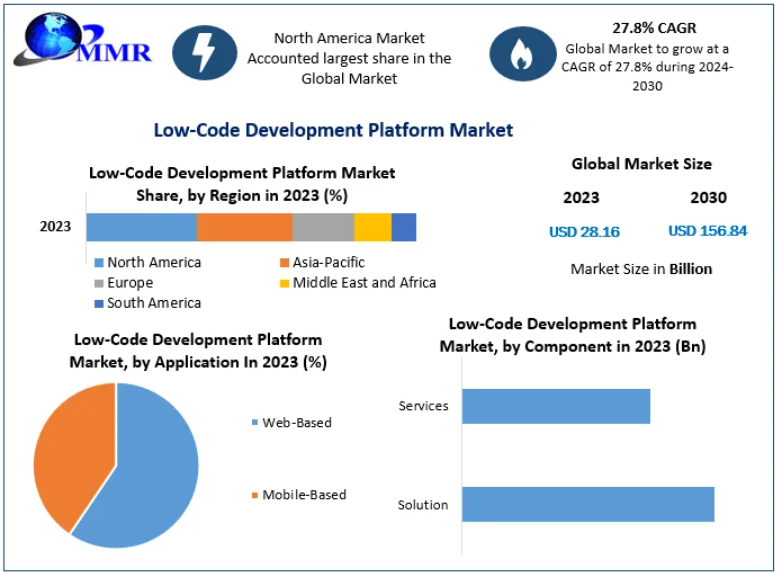
The Low-Code Development Platform Market, valued at USD 28.16 billion in 2023, is on track for exponential expansion, projected to grow at a robust CAGR of 27.8% from 2024 to 2030. By the end of the forecast period, the market is expected to achieve nearly USD 156.84 billion, positioning low-code as a mainstream innovation for enterprise digitalization and application development at scale.
Low-Code Development Platform Market Overview
Low-code development represents a transformative shift in application creation, leveraging visual programming interfaces, drag-and-drop builders, prebuilt templates, connectors, and reusable components. This paradigm empowers both developers and non-technical “citizen developers” to build and deploy applications rapidly—cutting down development cycles significantly while reducing dependency on deep technical expertise.
Across industries, the need for accelerated digital transformation, automation, and simplified application development has fueled the adoption of low-code platforms. The technology is helping enterprises replace legacy systems, automate workflows, streamline customer journeys, and enhance operational agility.
To know the most attractive segments, click here for a free sample of the report:https://www.maximizemarketresearch.com/request-sample/55407/
Key Market Drivers and Opportunities
- Rising Digitalization Across Enterprises
Organizations worldwide are restructuring their operations to align with digital ecosystems. The push toward online services, cloud migration, remote work models, and digital customer interactions has accelerated the adoption of low-code platforms. Companies are increasingly equipping employees with digital tools to speed up workflows, reduce manual intervention, and improve efficiency.
The shortage of skilled IT professionals globally further enhances the value of low-code solutions, enabling teams to innovate without heavy reliance on specialized programming skills.
- Operational Efficiency Through Workflow Automation
Automation has become essential for enterprises looking to minimize errors, reduce costs, and streamline processes. Low-code platforms allow organizations to automate paper-based and repetitive workflows with ease.
Key benefits driving adoption:
- Rapid development of data capture applications
- Built-in connectors to integrate with enterprise systems
- Workflow modeling for customer and employee interactions
- Reduction in development backlogs for IT teams
By empowering business analysts and process owners to design and automate workflows independently, organizations can innovate faster and scale operations efficiently.
- Seamless Integration Through Smart Stitching
Modern enterprises operate within ecosystems made up of microservices, APIs, FaaS models, and legacy infrastructures. Low-code enables companies to stitch together various systems by creating lightweight, domain-specific applications that integrate seamlessly with existing architecture.
This “smart stitching” helps organizations:
- Avoid replacing entire legacy systems
- Improve interoperability
- Maintain business continuity while modernizing gradually
As cloud-native architectures grow, low-code platforms are becoming essential in bridging old and new technology stacks.
- Growing Opportunities in BYOD and Digital Workplace Models
The adoption of Bring-Your-Own-Device (BYOD) and remote work policies has widened the scope for low-code applications that support distributed teams. Companies are exploring low-code solutions to develop secure mobile and web applications quickly, ensuring seamless digital access for global workforces.
Market Challenges
Despite strong momentum, the market faces a few limitations:
- Limited integration capability with certain enterprise-grade tools
- Restricted customization across some low-code platforms
- Risk of creating isolated applications if architectural governance is weak
These factors could slow the adoption rate, especially among organizations with highly complex infrastructure needs.
Market Segment Analysis
By Industry
The BFSI sector accounted for over 30% of market share in 2023, the largest among all industries. Financial organizations are using low-code to digitize core operations, including:
- Customer onboarding
- Loan origination
- Compliance workflows
- Back-office automation
- Self-service portals
The need for rapid application delivery, regulatory updates, and seamless digital banking experiences has accelerated low-code adoption across global banks and insurers.
Other rapidly growing industry segments include:
- Telecom & IT – modernizing customer support and network management
- Government – digital public services, documentation, and workflow automation
- Healthcare & Life Sciences – patient management and clinical workflow tools
- Retail & E-commerce – inventory, order management & digital storefronts
- Education – learning management platforms and administrative automation
To know the most attractive segments, click here for a free sample of the report:https://www.maximizemarketresearch.com/request-sample/55407/
Regional Insights
North America – Market Leader (35% Share in 2023)
North America dominates the global low-code market due to:
- Presence of innovation-led companies
- High investment in R&D
- Early adoption of digital and cloud technologies
- Significant demand for enterprise automation
The United States plays a pivotal role, with companies rapidly integrating low-code into digital transformation strategies. Launches by major vendors—such as ServiceNow and Claris—have strengthened the region’s market leadership.
Asia Pacific – Fastest Growing Region
Asia Pacific is set to witness rapid expansion driven by:
- Rising digital-first initiatives in China and India
- Expansion of SME adoption
- Government support for digital innovation programs
- Increasing focus on workflow automation
India’s Atmanirbhar Bharat initiative, combined with accelerated cloud adoption, is contributing significantly to platform uptake.
Europe – Strong Growth in BFSI and Manufacturing
European enterprises, especially in the UK and Germany, are embracing low-code platforms to upgrade digital infrastructures, modernize legacy systems, and improve customer experiences. The region also benefits from a strong push toward automation across BFSI, healthcare, and retail.
South America, Middle East & Africa – Emerging Adoption
These regions are in earlier phases of automation adoption, but digitalization across enterprises is driving demand. Brazil leads the South American market, while GCC countries, South Africa, and Turkey show promising potential due to rising internet penetration and digital readiness.
Key Players in the Market
Prominent companies shaping the global low-code ecosystem include:
- Caspio
- OutSystems
- Appian
- Salesforce
- Quickbase, Inc.
- LANSA Inc.
- ServiceNow
- AgilePoint, Inc.
- Bizagi
- Microsoft Corporation
- Oracle Corporation
- Pegasystems Inc.
- KissFlow
- Blazedpath
- Mendix Technology BV
- Appsemble BV.
- Novulo
- Smart Shaped SRL
- Aurachain
- ClickPaas
- eNextCloud
- Zoho Corporation
- Magic Software Enterprises Ltd
These companies are continuously investing in AI integration, automation capabilities, multicloud deployment, and customizable development frameworks to strengthen their market position.
Conclusion
The Low-Code Development Platform Market is experiencing an unprecedented growth surge as enterprises worldwide accelerate digital transformation initiatives. With rising demand for workflow automation, rapid application development, and reduced IT dependency, low-code has moved from a niche tool to a critical enterprise technology.
As organizations navigate hybrid work models, legacy system modernization, and increased customer expectations, low-code platforms will play a central role in enabling scalable, cost-effective, and agile application development—reshaping the global digital landscape through 2030 and beyond.